The Call to ‘Contaminate’ Africa

author profile image
Article By Daniel Bourdanné
A book is more than just a commodity for sale, it is first and foremost an inner passion. The spark that will ignite a revolution in the book industry in Africa, will not be a technological skill, easy transportation, or a stable currency. These things will certainly be useful tools if they are well understood and harnessed strategically for the book industry.
A book is more than just a commodity for sale, it is first and foremost an inner passion
The decisive factor will be the inner movement which is a passion for books; that prompts people to read, write, and dream up books in different forms and formats. It is this passion on the inside that can ‘contaminate’ Africa, posited Daniel Bourdanné, it is not what comes from the outside that contaminates. What contaminates, comes from the inside out – paraphrasing Jesus from Mark 7:14, at the first Africa Speaks Consultation in 2018.

When I started restructuring the PBA (Presses Bibliques Africaines), I had no capital. But something drove me on – a passion for books. I deeply believed in books as agents of change, training, encounters with people, dialogue, gateways to life, a sure path to transformation. I went into debt to produce my first book. Thankfully I was able to repay the debt in a short time even with little experience and no training in publishing.

To produce my first magazine, I enlisted the help of four other friends. I convinced them to put some of their money into it. We scraped together some contributions to run the first issue of the magazine. The magazine survived, debt-free until the group broke up as people began moving elsewhere. I double-hatted as the administrator and left the money collected in the magazine’s account when we closed it. When problems arose, we were ready to re-invest. We never depended on external aid save for an 80-dollar gift we received once from some missionaries.

We never depended on external aid save for an 80-dollar gift we received once from some missionaries.

What we African publishing players need to do, first and foremost, is grow the passion for books in us. I would describe this passion as a calling. The word “calling” is pregnant with meaning. It refers to something that dwells deep within and drives us, such that we keep pressing ahead even in the face of difficulty. There is no denying that the meaning of the word “calling” tends to wane and shrink as the Christian arena becomes increasingly professionalized. However, the fact remains that as players of Africa’s book industry, we need to have a calling.

Be it in written or oral form, electronic or any other format, produced using print on demand technology or through more conventional methods; we must love books and nurture a love for them. This passion and love of books must give rise to a hymn to the joy of reading, writing, and explaining the art of storytelling. Africa will not have its book publishing revolution until we win the battle of loving books; of reconciling orality and writing.
Africa will not have its book publishing revolution until we win the battle of loving books

Africa is made up of community people who want to meet each other. We ought to read in order to meet each other. Written or oral accounts of curious events work better – not necessarily because they are better written, or are literary masterpieces; but because people get connected through their stories. So, we meet to share these stories and spread them by word of mouth. What do people do with their mobile phones? They share interesting tidbits, things said on YouTube.

I personally own three physical libraries which contain hundreds and sometimes thousands of books, each. There is one library in my home, one in my office, and one back in Ivory Coast. Someone once asked me what I will do with my books when I return to Africa or when I move. But for me, even with the space issue, any suggestion to discard my books is insulting. The books in my library are generally in good condition. It pains me deeply to see someone open a book and fold it in two.
I personally own three physical libraries which contain hundreds and sometimes thousands of books, each… even with the space issue, any suggestion to discard my books is insulting

But why such a great love for books? The Frenchman, Jacques Chancel, loved to say: “Let there be no doubt about it, it is books that beam the small lights that are able to inform the world, that light candles which serve as benchmarks, markers, that give warning to tyrants and weak people…”.

Does this quotation from Jacques Chancel not take us, as Christians, back to Psalms 119:105; “Your word is a lamp to guide my feet and a light for my path”? For Christians, books are life because the word is eternal life. Christianity is the religion of the book. We are people of the book. The book is about transformation. Books shift centers of power to the fringes. They lessen the dangers of ignorance.
Books shift centers of power to the fringes. They lessen the dangers of ignorance.
Those who come into publishing: writers, publishers, producers, printers must come chiefly motivated by this inner passion for books as a means of transforming Africa. It is this passion that motivates, inspires, equips people with grit, resilience, and creativity.

author profile image

Daniel Bourdanné

Daniel Bourdanné served as General Secretary of the International Fellowship of Evangelical Students for 12 years from 2007 – 2019. He was a consultant/advisor in the Africa Leadership Study and former Chair of the Board of CPE (Centre de Publications Évangélique) Publishing. He is a writer and editor; founded a Christian magazine – Le Réformateur Chrétien; managed a Christian publishing house PBA (Les Presses Bibliques Africaines), and served as a Board member of Africa Regional Bible Society and Board Member of Bible Society of Côté D’Ivoire.

Visible Signs That The Time Has Come For Us To Act

author profile image
Article By Africa Speaks
There is no doubt that Africa’s Christian publishing industry faces real and daunting challenges. From logistical constraints, challenges of finding good printers, and scarcity of good writers. There are also challenges of working with authors; meeting deadlines is no easy task, unlike what obtains in the West.

In contexts like French, Portuguese, and Arabic-speaking Africa, the shortage of evangelical Christian literature, in any form, continues to cause severe famine. The evangelical Christian population is generally small, which means the market is narrow. Since mainstream Christianity is English-speaking, these communities cannot enjoy the wealth of resources available in English-speaking countries. Furthermore, raising financial capital locally is a challenge. In the West, when you have a good project, you can get a bank to back you. But in Africa, it doesn’t usually work that way.

The players in the industry, therefore, need to be intentional about helping the industry to blossom and flourish. Daniel Bourdanné, in his keynote speech at the Africa Speaks consultation shared the following as the clear and visible signs that the time is right to work to help Africa’s Christian publishing industry blossom;

The extraordinary numeric growth of Christianity in Africa. Africa’s Christian demographic growth is picking up momentum. Christianity’s centre of gravity has shifted. There is a need to publish, popularize, and water Christian Africa with high-quality biblical thought. We must prevent a famine of Christian books from taking root in Africa.

Missions are now polycentric, working on all fronts. African biblical thought must be shared, lavishly displayed before the world as Africa’s contribution to God’s mission worldwide. If meaningful theology is the kind that is developed where the majority of Christians are found, then the Christian publishing industry needs to prosper in order to support the spread of African biblical thought.

Technological progress, the vibrant creativity of Africa’s youth offers potential for the viability of the publishing industry: The Internet, optical fibres which are currently circling Africa, the availability of money transfer services, cloud technology that allows text exchanges, print on demand technology, virtual currencies, and new global partnership opportunities.

A growing trend of entrepreneurship among youths. This spirit of entrepreneurship means the publishing industry could be regarded as a genuinely conducive birthplace for profitable businesses, where writers can reap great rewards from their work and where financial actors can risk venture capital. Educators will see the need to invest in publishing-related training because it would be lucrative for them. And even though it may not yield immediate profits, partners will see the need for strategic investments and take a chance by investing part of their profits with a view to medium and long-term profitability.

Africa’s burgeoning population. In the near future, Africa’s population will reach one billion. A growing number of people can read. A potential market will materialize.

An increasingly holistic approach to Christian publishing. There is increasing awareness of the need to avoid ghettoizing Christian publishing. There is a need to explore non-Christian market penetration. The Gospel is not meant only for Christians. Such an understanding of publishing would extend the market’s exposure beyond Christian circles.
Despite these clear signs, the task of developing the Christian publishing industry is viewed by many as a battle of the Israelites against the giant Goliath; a hopeless endeavour.
Despite these clear signs, the task of developing the Christian publishing industry is viewed by many as a battle of the Israelites against the giant Goliath; a hopeless endeavour. It is precisely this Old Testament passage, and the victory God enabled David to achieve – through a change in viewpoint and in perspective – that should inspire hope that Africa’s book industry can be developed.

Find out how you can be part of the Africa Speaks Community: An international network of professionals committed to a flourishing Christian publishing industry in Africa.

author profile image

Africa Speaks

Africa Speaks is an international network of professionals committed to a flourishing Christian publishing industry in Africa.

CLC Kenya Holds a Christian Authors Book Award (ACABA) Gala

author profile image
Article By Africa Speaks
Saturday 27th November was a remarkable milestone for the Christian publishing industry in Kenya and East Africa. The event dubbed the ACABA Gala, hosted by CLC Kenya was held at the International Leadership University, a hybrid event that was also streamed live on online platforms.
 
Mercy Muthoni – CLC National Director
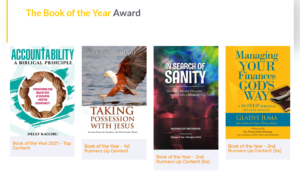
    The aim of the award program is to recognize, celebrate, and promote quality in Christian authorship in East Africa. Seventy-four books were nominated for the awards and were reviewed by a panel of 12 judges. They were classified into 10 categories; young readers, family, men and women, missions, Church and theology, Christian living, culture, history and biography, and leadership. The award process flagged off in June 2021 included receiving nominations, appointing judges and judging criteria, assessing the books, culminating in the award gala. The program celebrated the “best of the year” in the categories and five finalists were chosen in each category unless there was a tie. The winner in each category was announced and awarded at the gala. In total there were 13 awardees, with the other three awards being; content of the year, book cover of the year, and book program of the year. The first two came with a cash price of Kenya Shillings 50,000 worth of printing from CLC Kenya.
 
  Top Content Overall Finalists
    In the keynote speech, Bishop Dr. Stephen Kanyia of the Redeemed Gospel Church of Kenya emphasized the importance of reading and writing to transform mindsets. He commended the organisers of ACABA for their efforts to enhance professionalism in African writing. As a preacher who reads many Bible commentaries, he said his favourite is the Africa Bible Commentary because it’s written by African authors, “in a context I can easily identify with.” The judges were impressed by the rich quality and content of books contrary to popular belief that African writers’ quality of writing is poor. While celebrating the good writing, they pointed out areas that need improvements such as the need for proper research, referencing and citation, and thorough editing. They noted there were books that seemed to merely repeat scripture, simply transcribed sermons, lacked professionalism especially in choice of cover and layout, needed a more solid theological foundation, and instances where the target audience was unclear. They highly commended the young authors and called for greater mentorship. The authors hailed the process as a very enriching experience where they networked and learnt from fellow authors, received mentorship and helpful insights from the ACABA team gained access to a wider audience thus getting the opportunity to reach beyond Kenya. The 2022 book submission call is open and the window runs from November 2021 – August 2022. The speakers at the award gala expressed their longing for an Africa wide writing competition and continental gala. Patrick Omukhango a director at CLC Kenya was a participant in the initial Africa Speaks conference and Liz Patten, Regional Director of CLC Africa is the secretary of the Trustees of Africa Speaks network.  
The speakers at the award gala expressed their longing for an Africa wide writing competition and continental gala.
  This was surely a momentous occasion for us in Africa Speaks who are committed to working together to foster a flourishing African publishing industry for the enrichment of the Church and society in Africa and throughout the world.

author profile image

Africa Speaks

Africa Speaks is an informal, international network of professionals committed to a flourishing Christian publishing industry in Africa.